
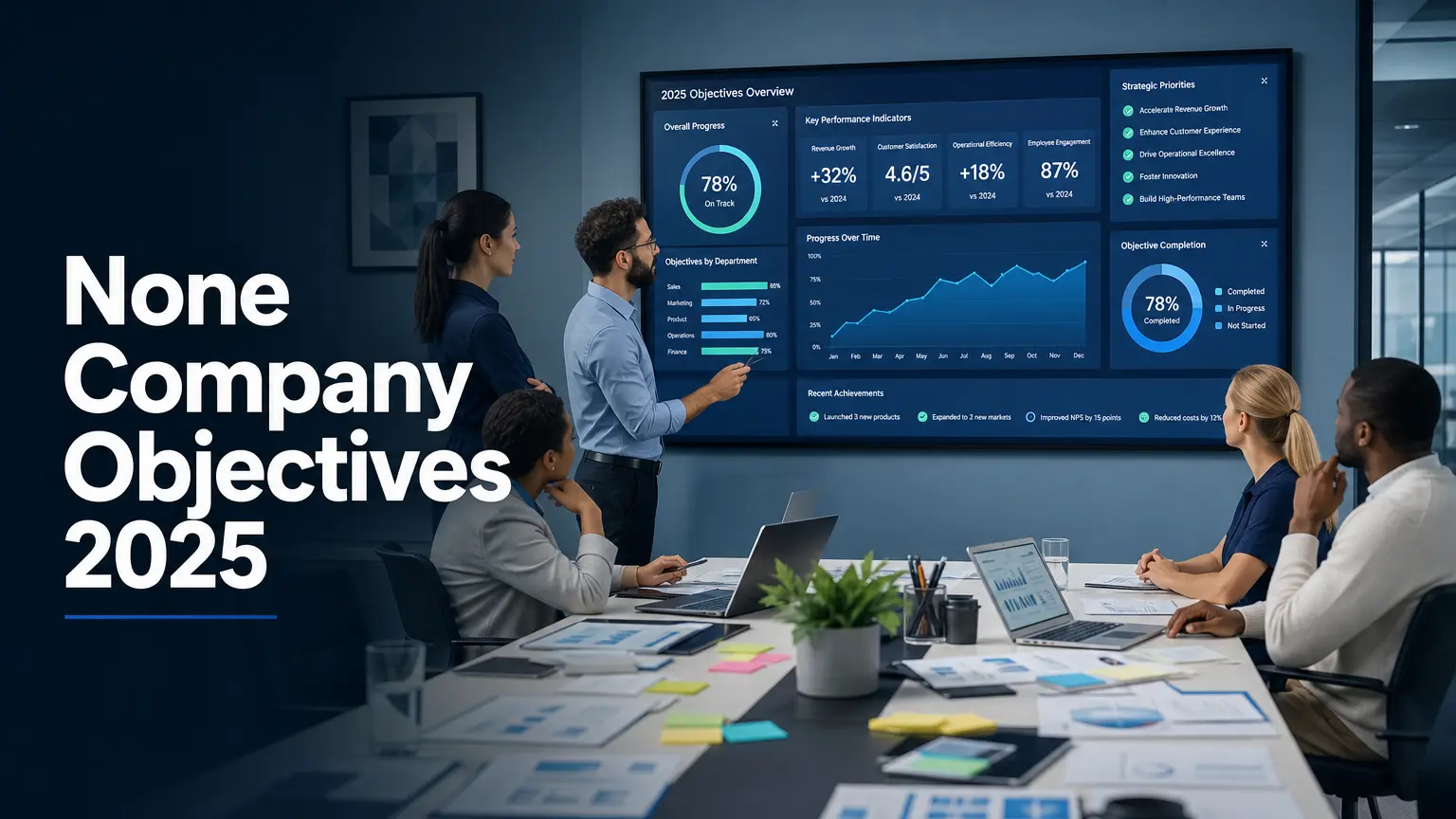
Setting clear company objectives has always been critical, but 2025 demands a sharper, more disciplined approach than ever before. Markets are shifting faster, customer expectations are evolving continuously, and the margin for aimless execution is practically gone. None Company Objectives 2025 isn’t just a planning exercise — it’s a strategic commitment to growth, accountability, and long-term value creation. Whether you’re running a ten-person startup or managing a mid-sized enterprise, the way you define and pursue your objectives this year will determine whether you scale confidently or stagnate quietly. This guide walks you through the eight most powerful strategic pillars that turn intentions into measurable, repeatable results.
Why Traditional Goal-Setting No Longer Works in 2025
Most companies still rely on annual planning cycles that were designed for a slower, more predictable world. The problem? 2025 doesn’t reward slow. A goal set in January can become irrelevant by April if market conditions shift, a competitor pivots aggressively, or a new technology disrupts your category.
Traditional goal-setting treats objectives as fixed destinations, but modern businesses need them to function more like a GPS — constantly recalibrating based on real-time data. Companies that clung to rigid quarterly targets in recent years watched those targets become liabilities.
The businesses that outperformed them adopted rolling planning cycles, reviewed objectives monthly, and gave their teams the authority to adapt without waiting for executive sign-off. That mindset shift is the real foundation of effective None Company Objectives 2025 strategy.
Connecting Every Objective to a Measurable Business Outcome
Vague objectives are expensive. When a team works toward something like “improve customer experience” without a defined metric attached, they can spend six months doing activity that feels productive but moves no needle.
Every objective you set in 2025 needs a direct line to a number — revenue, retention rate, customer acquisition cost, net promoter score, or margin. For example, instead of “grow the brand,” the objective becomes “increase organic website traffic by 35% by Q3, contributing to a 20% rise in inbound leads.
That specificity creates alignment, makes progress visible, and removes ambiguity about what success actually looks like. Tying objectives to measurable outcomes also makes it much easier to identify when something isn’t working and course-correct before it becomes a serious problem.
Building Objectives Around Your Customers, Not Your Competitors
A common mistake companies make is designing their objectives entirely in reaction to what competitors are doing. You see a rival launch a new product, and suddenly the whole roadmap shifts. You notice a competitor cutting prices, and your team scrambles to match them.
This reactive posture is exhausting and often counterproductive. The strongest None Company Objectives 2025 frameworks keep the customer at the center, not the competition. Start by asking what your customers are struggling with that you’re not yet solving.
Ask what would make them choose you not just once, but repeatedly. When objectives are anchored in genuine customer insight — supported by survey data, support tickets, churn interviews, and usage analytics — the work your teams do carries more weight and earns more loyalty.
Using Technology to Set Smarter, Faster Objectives
The companies pulling ahead in 2025 aren’t just working harder — they’re using better tools to work smarter. Artificial intelligence, predictive analytics, and business intelligence platforms have made it possible to spot trends months before they become obvious, model different growth scenarios with reasonable accuracy, and track objective progress in real time rather than waiting for monthly reports.
Tools like Tableau, Looker, or even well-configured CRM dashboards can surface the data signals that should inform your objectives before you finalize them. The goal isn’t to let technology replace strategic thinking — it’s to make that thinking faster and better-informed.
Companies that integrate data tools into their planning cycles consistently set more realistic objectives and hit them at a higher rate than those still relying on gut feel and spreadsheets.
Aligning Leadership, Middle Management, and Frontline Teams
One of the most underappreciated reasons companies miss their objectives is misalignment between levels of the organization. Leadership sets a bold vision. Middle managers interpret it through their own lens. Frontline teams execute based on what their direct managers communicate — which may bear little resemblance to the original intent.
By the time the work reaches the customer, it’s often a diluted version of what was planned. Effective None Company Objectives 2025 implementation requires a clear communication cascade — from boardroom to team lead — where every level understands not just what the objective is, but why it matters and how their specific role connects to it.
Companies that run structured OKR (Objectives and Key Results) sessions across all levels reduce this misalignment dramatically and see faster, more cohesive execution.
Making Accountability a Cultural Norm, Not a Punitive Measure
Accountability gets a bad reputation because most organizations treat it as something that only shows up when something goes wrong. Someone misses a target, and suddenly there’s a tense review meeting. That model breeds fear and dishonesty — people start managing optics instead of managing outcomes.
High-performing companies in 2025 treat accountability as a daily practice, not a quarterly reckoning. This means weekly check-ins where teams report progress without shame, transparent dashboards where objective status is visible to everyone, and leaders who model accountability by openly discussing their own progress and setbacks.
When accountability becomes part of the culture rather than a management tool, teams self-correct faster, problems surface earlier, and objectives stay on track without requiring constant top-down pressure.
Prioritizing Operational Efficiency as a Growth Lever
Many companies treat efficiency and growth as competing priorities, as if investing in operational improvements comes at the expense of expansion. That framing is outdated. In 2025, operational efficiency is a growth lever.
When your internal processes are tight — when handoffs between teams are clean, when tools are integrated rather than siloed, when workflows are documented and repeatable — you can scale without proportionally scaling your headcount or costs.
Companies that have invested in process optimization through automation, standard operating procedures, and streamlined communication tools consistently report faster time-to-market, lower error rates, and higher employee satisfaction.
Building operational efficiency into your None Company Objectives 2025 roadmap isn’t about cutting corners — it’s about creating the capacity to grow without friction.
Reviewing and Adjusting Objectives With Confidence Mid-Year
There’s a persistent myth that changing an objective mid-year signals weakness or poor planning. In reality, the most successful companies treat objective reviews as a sign of organizational health. Markets change, assumptions get tested, and new information demands a response.
The key is distinguishing between a legitimate pivot — driven by real data and strategic insight — and a reactionary change driven by short-term pressure or internal politics.
Build formal review checkpoints into your planning calendar, ideally every six to eight weeks, where leadership assesses whether the original objectives still make sense given current conditions.
Make it safe for teams to raise concerns about targets that have become unrealistic. That openness will save you more time and money than stubbornly defending an objective that no longer serves the business.
Conclusion: Turning None Company Objectives 2025 Into Lasting Results
The difference between companies that achieve their objectives and those that don’t rarely comes down to the quality of the goals themselves. It comes down to the discipline of execution, the clarity of communication, and the willingness to adapt without losing direction.
None Company Objectives 2025 done right means setting goals your teams actually understand, measuring the things that genuinely matter, building accountability into daily culture, and reviewing progress with honesty and frequency.
The businesses that will look back on 2025 as a breakthrough year are the ones starting that work now — not waiting for the perfect moment, the perfect strategy, or the perfect market conditions. Start with one clear objective, execute it well, and let that momentum carry everything else forward.