
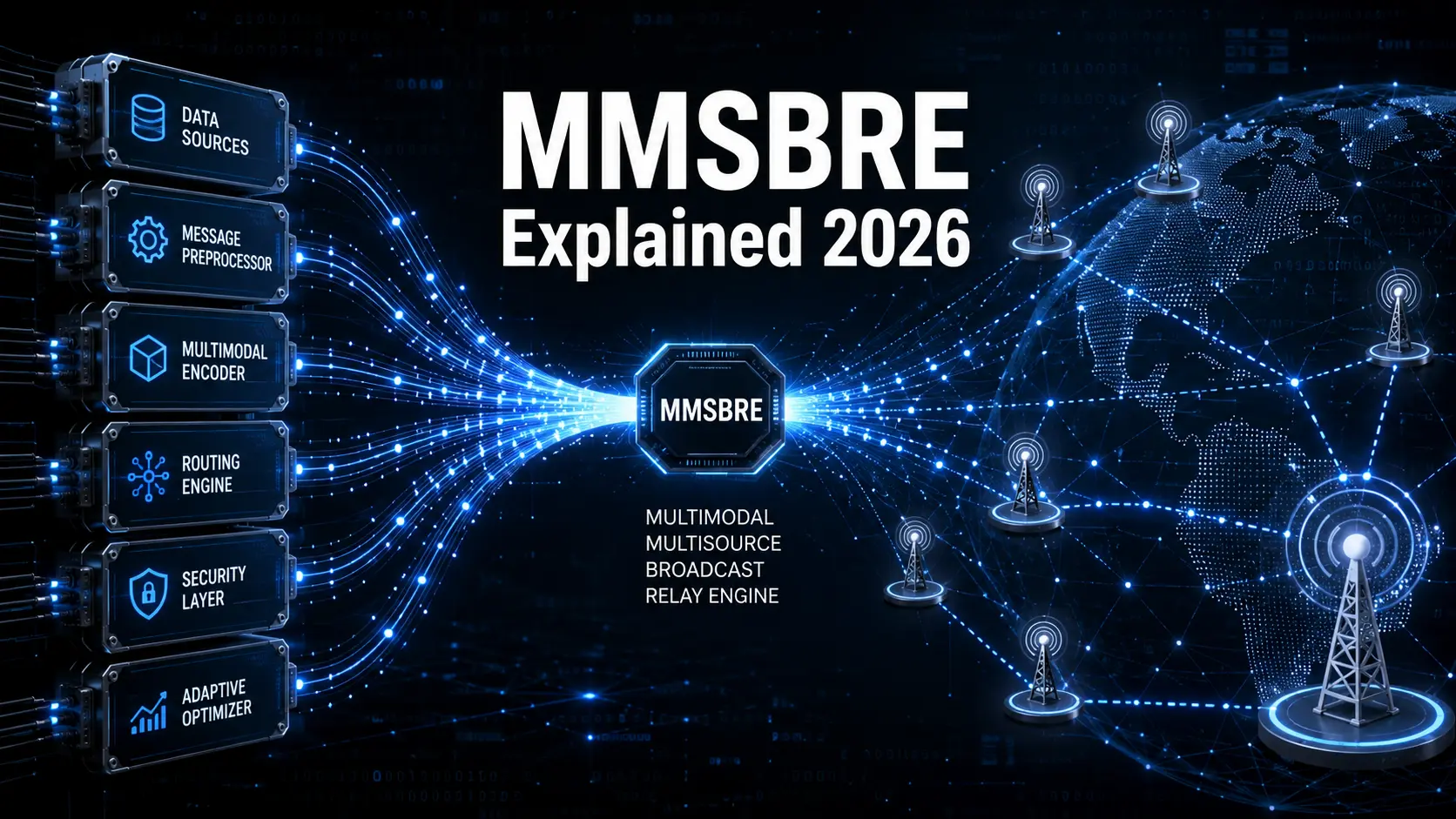
You’ve probably seen the word MMSBRE pop up in a tech article, a search result, or maybe a conversation about digital tools — and walked away more confused than when you started. That’s completely normal. Most people who encounter MMSBRE for the first time feel the same way because it doesn’t look like a regular word and it doesn’t have one single definition that everyone agrees on.
Here’s the honest truth: MMSBRE means different things depending on where you find it. In media and streaming, it stands for Multi-Media Streaming Broadcast Relay Environment — basically the invisible technical backbone that makes live video, online streams, and broadcast content travel smoothly from one point to millions of viewers without falling apart. Think of it as the infrastructure under the floor, not the floor itself.
In business and digital operations, the same term shifts meaning. There, MMSBRE is understood as a Modular Multi-Sided Business Resource Ecosystem — a system that connects your tools, automates tasks, and keeps teams and workflows running in sync, especially when those teams are spread across different locations or using different software.
Both interpretations share one core idea: making complex digital systems work together in a cleaner, smarter way. That’s what makes MMSBRE relevant regardless of which industry you’re in.
Why MMSBRE Is Getting So Much Attention Right Now
It’s 2026, and the digital world isn’t slowing down. Businesses are running five, ten, sometimes fifteen different software tools at the same time — and most of those tools don’t communicate with each other naturally. That creates delays, errors, and a lot of manual work that didn’t have to exist.
MMSBRE addresses exactly that problem. Whether you’re a content creator managing a live stream audience of 200,000 people or a project manager trying to connect your CRM, your task tracker, and your communication platform, the core need is the same: things have to flow.
What makes this concept stand out from older frameworks is its flexibility. Traditional systems were rigid — you built them once, they worked one way, and changing them took months. MMSBRE, by contrast, is modular, meaning it’s designed to adapt. You can add pieces, remove pieces, and restructure how things connect without breaking everything else.
This is why tech blogs, LinkedIn thought leaders, and digital operations teams are all talking about it. It’s not hype for the sake of hype. It actually solves something real.
How MMSBRE Works in Streaming and Media
If you’ve ever watched a live sports match with 800,000 people streaming simultaneously — no major lag, no quality drops, smooth delivery across different devices and internet speeds — that’s MMSBRE-type infrastructure doing its job quietly in the background.
The relay part of the name is key. In a traditional setup, content travels from point A to point B directly. But when millions of viewers are involved, that direct route can’t handle the load. A relay environment creates multiple pathways, distributes the signal intelligently, and adjusts based on network conditions in real time.
For creators, media companies, and broadcasters, understanding this system matters because it explains why some streams always feel smooth while others buffer constantly. It’s not always the internet connection. Often, it’s the relay infrastructure behind the platform that makes the difference.
Platforms investing in this kind of environment in 2026 are seeing measurable improvements — some reporting up to 40% reduction in buffering events and significantly higher viewer retention during peak traffic hours.
How MMSBRE Applies to Business Operations
On the business side, MMSBRE works more like an operating philosophy than a single piece of software. The modular element means your business systems aren’t locked into one structure. You build processes in connected blocks that can be rearranged as your needs change.
Practically speaking, this looks like automating the handoff between your sales pipeline and your project management tool, so your team doesn’t have to copy information manually. Or connecting your analytics dashboard to your communication platform so insights reach the right people without someone having to write a weekly report.
The multi-sided aspect is particularly important for businesses that deal with multiple types of users or partners — say, a platform that serves both vendors and customers. MMSBRE-style ecosystems are built to handle those different sides without treating them all identically, which reduces friction and improves outcomes on each side.
Companies that have adopted this kind of modular approach report faster onboarding for new tools, fewer breakdowns when processes change, and measurably better collaboration across departments.
Common Mistakes People Make When Thinking About MMSBRE
The biggest misunderstanding is treating MMSBRE as a single product you can download or buy. It’s not. It’s a framework and a concept — which means the value comes from how you apply it, not from installing it.
Another mistake is assuming it only applies to large companies with big tech teams. That’s not accurate. A solo creator with a growing streaming audience can benefit from relay environment thinking just as much as an enterprise with 500 employees. The scale changes, but the principles don’t.
People also make the mistake of trying to implement everything at once. The modular nature of MMSBRE is actually an invitation to start small — pick one broken connection in your workflow, fix it using these principles, and build from there. Trying to restructure everything simultaneously defeats the purpose of modularity entirely.
Finally, don’t confuse flexibility with a lack of structure. MMSBRE still requires a clear system. The difference is that the structure can evolve without collapsing.
Real-World Examples Worth Knowing
A mid-sized media company in the UK restructured its live broadcast system using MMSBRE principles in late 2025. By creating relay nodes across three server regions, they reduced average stream latency from 6 seconds to under 1.5 seconds — a meaningful improvement for live audience engagement.
On the business side, a SaaS startup with a remote team of 35 people built a modular resource ecosystem connecting their Notion workspace, Slack channels, CRM, and billing software. The result was a 30% drop in time spent on administrative follow-ups, because the system handled handoffs automatically.
These aren’t isolated cases. As digital complexity grows, more teams are finding that MMSBRE-style thinking is simply what makes operations sustainable at scale.
Frequently Asked Questions About MMSBRE
What does MMSBRE stand for?
MMSBRE most commonly stands for Multi-Media Streaming Broadcast Relay Environment in tech and media contexts. In business, it refers to a Modular Multi-Sided Business Resource Ecosystem. Both definitions share a focus on making complex digital systems work together more efficiently.
Is MMSBRE a software product or a concept?
It’s a concept and framework, not a product you install. You apply MMSBRE principles to design how your tools, workflows, or media infrastructure connect and operate together.
Why is MMSBRE suddenly trending in 2026?
Because businesses and creators are managing more digital tools than ever before, and those tools rarely communicate well. MMSBRE offers a structured yet flexible way to solve that problem, which is why it’s getting attention across tech and business communities.
Can small businesses or solo creators use MMSBRE?
Yes. The modular nature means you can start small. A solo creator can apply relay environment thinking to their streaming setup, and a small team can use ecosystem principles to connect just two or three tools effectively.
How is MMSBRE different from older digital frameworks?
Most older frameworks were rigid and linear. MMSBRE is designed to be modular and adaptive — you can change parts of the system without rebuilding everything from scratch. That flexibility is what sets it apart in fast-moving digital environments.
Do I need a technical background to understand or use MMSBRE?
Not necessarily. The core idea is straightforward: connect your digital systems in a way that’s organized, flexible, and efficient. Technical depth helps when implementing streaming infrastructure, but the business ecosystem side is accessible to anyone managing digital operations.
Final Words
MMSBRE is one of those concepts that sounds complicated on the surface but makes complete sense once you understand the problem it’s solving. Whether you’re running live streams, managing a team across different tools, or building a digital product, the core idea stays the same: your systems should work together, not against each other.
The key takeaways are simple. MMSBRE has two main interpretations — one for media streaming infrastructure, one for business ecosystems — but both are about better coordination. It’s a modular concept, meaning you don’t have to adopt it all at once. Start with the biggest bottleneck in your current system and apply the principles there first.
And don’t mistake its flexibility for a lack of structure — it still requires clear thinking and intentional design. As digital environments keep growing in complexity through 2026 and beyond, frameworks like MMSBRE aren’t just useful — they become necessary for anyone serious about running smooth, scalable digital operations. This is your Final signal to stop scrolling past the term and start paying attention to what it can actually do for you.